
How do they do it?
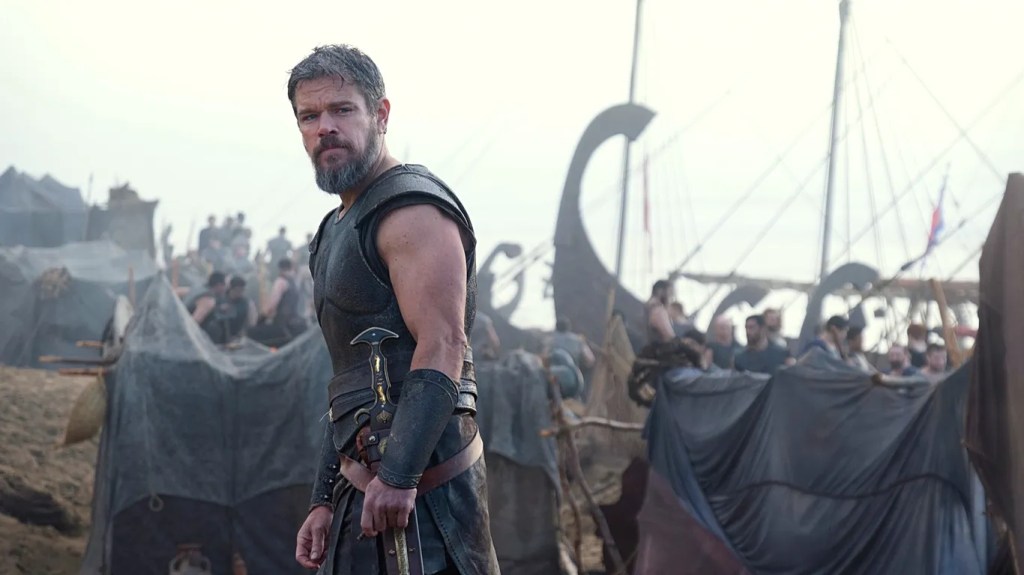
Since Nolan’s Odyssey opened a few weeks ago my feed on social media, my discussions with friends, my life, has been saturated by talk on this movie. It’s wonderful, a movie that gets people talking and breathes life into cinemas. But all this discussion is also driving me insane.
Spoilers ahead.
Every day we are bombarded by “takes” on the Odyssey based on its “wokeness”, its lack thereof, on whether it was historically accurate or not. I do not care about those first criticisms, they are typically lazy or racist. I will say that if someone wants to make an Odyssey played only by black female actors they are free to do so. And don’t get me started about Greeks complaining about their “representation.” Of course all of this is not to say that none made interesting critiques of the movie or that the you cannot prefer watching a more historical or “epic” movie.
No, what drives me insane is the talk about historical accuracy. All the world’s classicists have decided that this is the time to make shorts on social media to maybe squeeze a bit of money out of their degrees. An action I am annoyed by only because their criticisms are so flat. So, what is it exactly that they get wrong? Is the Odyssey, unbeknownst to its critics the perfect movie? Well…
I am not a historian, and while I did the Homeric epics in middle school I admit that I barely remember anything from those classes, certainly I don’t remember the exact wording of the ancient Greek. But you don’t need to be a historian to understand a movie. The issue most of these classicists have is that they identify the symptom but not the underlying problem and that they do not understand the “theory” of the movie.
Let’s begin with some context. Nolan’s Odyssey is an adaptation and an interpretation of an orally transmitted story, eventually attributed to Homer. The movie is made in a modern context and naturally many of the more heroically epic characteristics of the story are toned down to make space for Nolan’s affinity for a certain kind of naturalism. Furthermore the story is transformed, shortened and honed in on the message that Nolan wants to give, truly it is Nolan’s Odyssey, not Homer’s. And this Odyssey is about a few things, revenge, duty, homecoming. But most of all it tells a story of changing times.
People seem to take issue with that occasionally because they think that this movie is about history in the modern scientific sense. They make critiques about accuracy in costumes, about why the Trojan Horse is standing, about how the Sea People’s and the Bronze Age collapse’s handling are omitting the real Sea Peoples (especially this line is often misunderstood). Why, oh why, even name the movie the Odyssey if its merely an interpretation? Some of these points are actual problems of the movie, but by understanding the movie as a documentary rather than aesthetically you miss out on what the problems are.
When Tom Holland is dressed like he plays a role in the Witcher, when the soldiers of Odysseus are dressed in hoplite armor, what is shown is not a lack of understanding of the period. But what we are seeing is a lack of elaboration on the aesthetics of the period. Bluntly, it is boring when we can see artists creating (prompted by this movie) beautiful and alien designs based on historical depictions. There was thought put into all these designs until a point which then seems to drop off. That thought is much more visible in the sets used for Ithaca or Troy which are rather beautiful but fade naturally into the background. People seem to grasp this better with Odysseus character being stripped of some of his cleverness and the story being stripped of sex and humor.
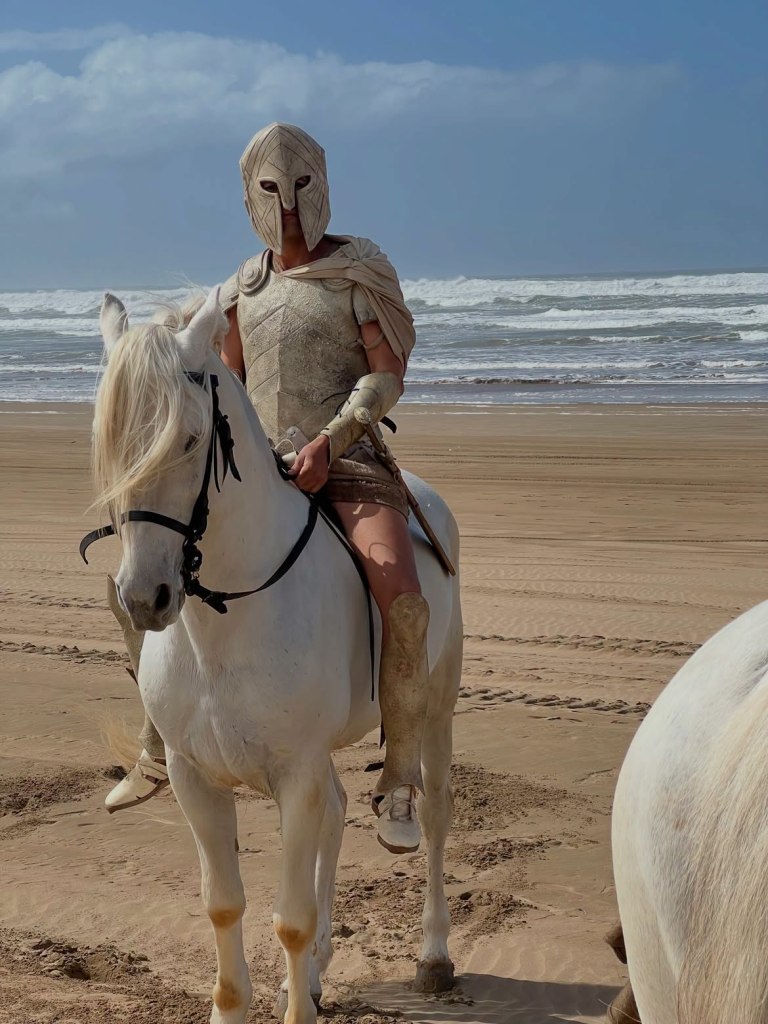
The issue of the historical elements added to the movie is also one that is slightly misunderstood. People seem to think that this movie’s Odysseus claims to be the Sea Peoples (those mysterious raiders that helped lead to the collapse of Bronze Age Greece). This brings us back to the main theme of the Odyssey, changing times. As mentioned, here, the changing of epochs is not understood as a historical process as much as it is a spiritual one. The “history” here is idealistic rather than critical. Think of it as a change in the “spirit of the times” that occurs when Troy is destroyed, not through honorable combat but through trickery that breaks the laws of the gods, namely hospitality. It’s this event and subsequent raids by the armies that conquered Troy that cause (at least in this film) the spread of war and eventual collapse.
The Bronze Age Collapse is meant to be the historical particular but the theme is meant to be carried further. In fact the movie is less about the transition of Bronze Age to Classical Greece, but references the Aeneid openly, foreshadowing the coming of Rome. A sin breaks the spirit of the old and gives birth to a new world. Occidental civilization takes its torch and carries it west. I would even go as far as seeing, in the way that Xenia (Zeus’ Law) is explained as the Golden Rule, as speaking of the transition from Judaism and Paganism to Christianity. And even more than just these transitions, the Trojan Horse’s parallels to the atomic bomb (see the review I have linked) also suggest the end point of history in which everything is allowed in war.
Then, the elements that are alluded to in the movie are not problematic because they are inaccurate, that’s not their point. But when Odysseus clunkily mentions how all of this is causing the “collapse of our age of bronze” it is the movie feeling insecure in itself and mistrusts the audience to understand its message. Perhaps Nolan and his screenwriters are right in that (if there was no truth to this there would be no need for this post) but tragically (ha!) they create the conditions for misunderstanding.
All of these things make Odysseus a man outside of time. He seems to understand what is coming: war, collapse, forgetting. This is not unproblematic either. It is what gives cause and urgency to his guilt. Nolan’s Odysseus is aware that he is responsible for the death of his crew and for the end of civilization. But while Matt Damon plays that role of a wrecked man very well, it makes the plot of the movie feel a bit too literal, yes there is this direct effect of the sack of Troy causing the Bronze Age collapse, and it makes the character a bit less… complicated.
Another thing that is a bit different in Nolan’s movie is the depiction of the gods. While monsters are definitely real, gods are… a mystery. While we see visions of Athena (played by Zendaya) it is not quite clear in what sense they exist. They appear as embodied, immanent in the elements, perhaps divinity here is closer to a platonist’s conception. Certainly we don’t see Athena or Hermes as people in the world.
As for the experience of watching the movie there are things that are undeniably well done and well acted. The horror of the Cyclops, the grotesqueness of Circe, the beauty of Odysseus’ bow. Speaking of acting it is one of the more mixed things in the movie. While all stars have their moments of shining there are definitely weaker parts. Especially Telemachus in my view, who has such a central role is shy of convincing us of feeling at home in the role of a prince. Penelope’s aggression towards him also seemed a bit misplaced though not badly acted. Almost all of the rest of the main roles were often times great, especially Morton as Circe and Nyong’o as Helen of Troy. I was also very positively surprised by Travis Scott’s appearance. But the role that surprised me the most was Benny Safdie’s Agamemnon. The supreme commander of the Achaeans is rendered into a symbol of cold might in this movie, Safdie folds such a sweet contrast into the icy symbolism that he immediately became my favorite part of the movie despite his short appearances.
As you can see the movie is not perfect and it’s not for everyone. It omits, cuts and rejoins, changes the Odyssey. Not always for the worse, but not always for the better.. But it does one thing that is of great value: It reflects on great themes cleverly.

