
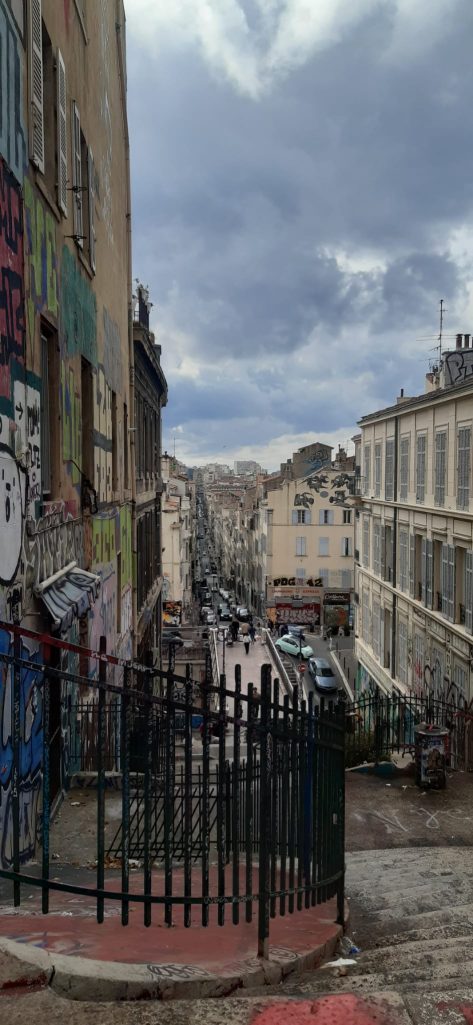
Text below is automatically generated based on the work produced for a presentation concerning Marseille as a potential focus for poverty and inequality research at the University Hagen. The city in the south of France is a particularly interesting case for many kinds of research from social fragmentation, privatization of public spaces, precarious independent work, housing and gentrification, and more. My hope is that, despite its autogenerated nature (excuse my laziness), it can still function as a primer for Students or Researchers that want to orient themselves before further research towards the city’s role as a post-colonial port or towards phenomena such as its delayed gentrification. As such I do believe it works quite well. The text is largely based on the work of Grzegorczyk, Aziz, Dorier, Gripsiou and Bergouignan and by extension Maloutas. Though for those looking to look further into these topics it is recommended to investigate the work of Roncayolo for a larger historical view.
Abstract
This text examines Marseille as a case study of poverty and inequality in France. Although the city has a lower Gini coefficient than Paris, it exhibits a particularly high spatial concentration of poverty and is home to several of the poorest arrondissements in France. The text focuses on the city’s historical development from the Belle Époque through decolonization and deindustrialization to the urban renewal projects since the 1990s. It argues that Marseille is characterized less by extreme wealth concentration than by pronounced socio-spatial fragmentation. Processes such as gentrification, the proliferation of gated communities, spatial segregation, and informal forms of work in public spaces illustrate how social inequality continues to visibly structure the city.
Primer
Marseille has long had a reputation as the unruly cousin of French port cities: charming, sunlit, diverse, and occasionally held together by little more than strong coffee and stubbornness. It offers all the ingredients of a Mediterranean postcard, then immediately complicates the picture with poverty, crumbling housing, and social divisions sharp enough to cut bread. . This is precisely why Marseille represents a particularly interesting case study for research on poverty and inequality in France. At first glance, however, the city seems surprisingly unsuitable for this purpose. Looking solely at the Gini coefficient, Paris appears significantly more unequal than Marseille. The Gini index in Paris was around 0.49 in 2011, while Marseille’s was approximately 0.43. However, a purely statistical analysis can be misleading. While Marseille is not among the cities with the highest concentration of wealth in France, it exhibits an exceptionally high spatial concentration of poverty. The city contains ten of the poorest arrondissements in France, with poverty rates that can reach up to 40 or even 50 percent, depending on the definition. Marseille is also considered the city with the second-largest poor population in France. Inequality structures the city not only socially but also spatially. It is precisely this socio-spatial dimension that makes Marseille particularly interesting for inequality research.
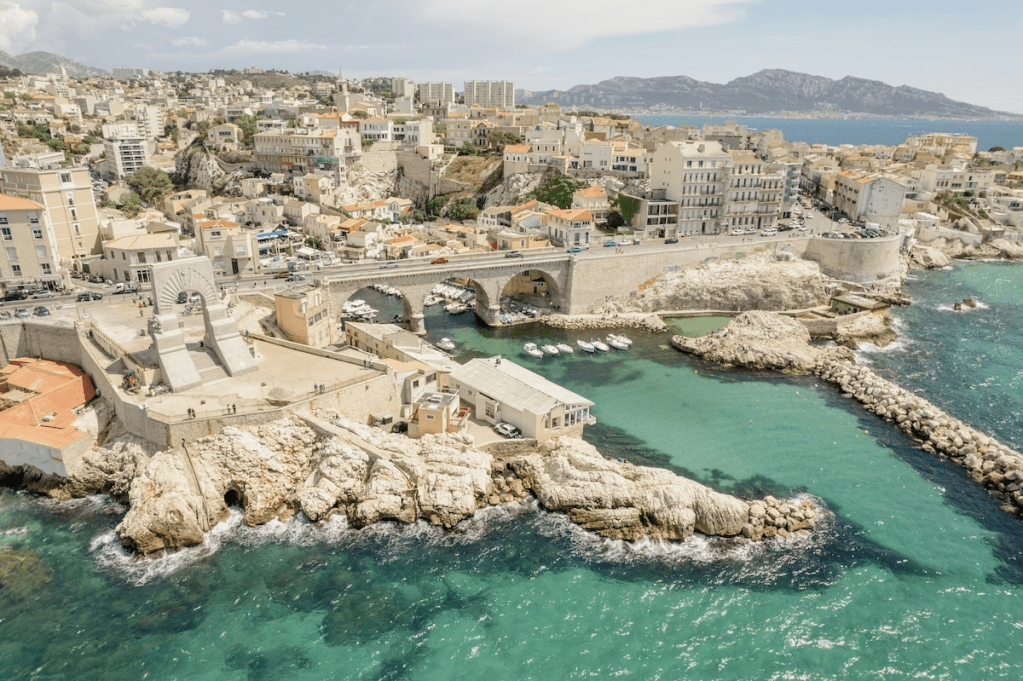
Chronicle of a port city
In some ways, Marseille initially follows the general historical pattern that Thomas Piketty also describes for France. During the Belle Époque, Marseille, too, was a city of stark social inequality. The city profited immensely from its role as a colonial port and trading center. The port economy, industry, and the merchant bourgeoisie enabled Marseille to reach an economic peak before the First World War. At the same time, stark social contrasts already existed between a wealthy port and trading elite and a large working-class population. Direct data on wealth concentration are harder to find for Marseille than for Paris, but there is considerable evidence to suggest that strong social stratification also existed there.
However, the post-war period ushered in a unique local development path for Marseille. While the period after 1945 initially marked a phase of reconstruction and modernization, with projects like the Cité Radieuse, the Tours Labourdette, and the Centre Bourse being symbolic of this phase, Marseille simultaneously lost its historical status as a colonial port. The decolonization of France hit the city particularly hard, as its economy was closely tied to colonial trade structures. This marked the beginning not only of economic transformation but also of a shift in the city’s “imaginary” identity.
However, perhaps more important for Marseille than national factors like the Tournant de la rigueur was the specific dynamic of deindustrialization. In the 1960s and 1970s, two processes occurred simultaneously: On the one hand, the city’s industry shrank considerably; on the other, it increasingly relocated from Marseille to regions like Fos-sur-Mer and Berre-l’Étang. The demise of the renowned fat and soap industry is particularly symbolic of this. The closure of large factories and the economic restructuring led to massive social consequences. Between 1975 and 1999, Marseille lost approximately 100,000 inhabitants. The city became increasingly characterized by unemployment, poverty, and spatial segregation. The 1970s to 1990s were therefore crucial for the current social structure of Marseille.
The major turning point came in the 1990s with large-scale investment and urban renewal projects. The election of Robert-Paul Vigouroux as mayor in 1986, as well as projects like Euroméditerranée, marked the beginning of a new urban policy. The goal was to make Marseille more internationally attractive, attract investment, and fundamentally change the city’s image. The development of major cultural projects, the redevelopment of the Vieux-Port, and later, the designation as European Capital of Culture in 2013, were key to this transformation. Since the early 2000s, the city’s population has slowly begun to grow again. However, this revival has been concentrated in certain central areas and has been linked to a change in their social character.
Local structures
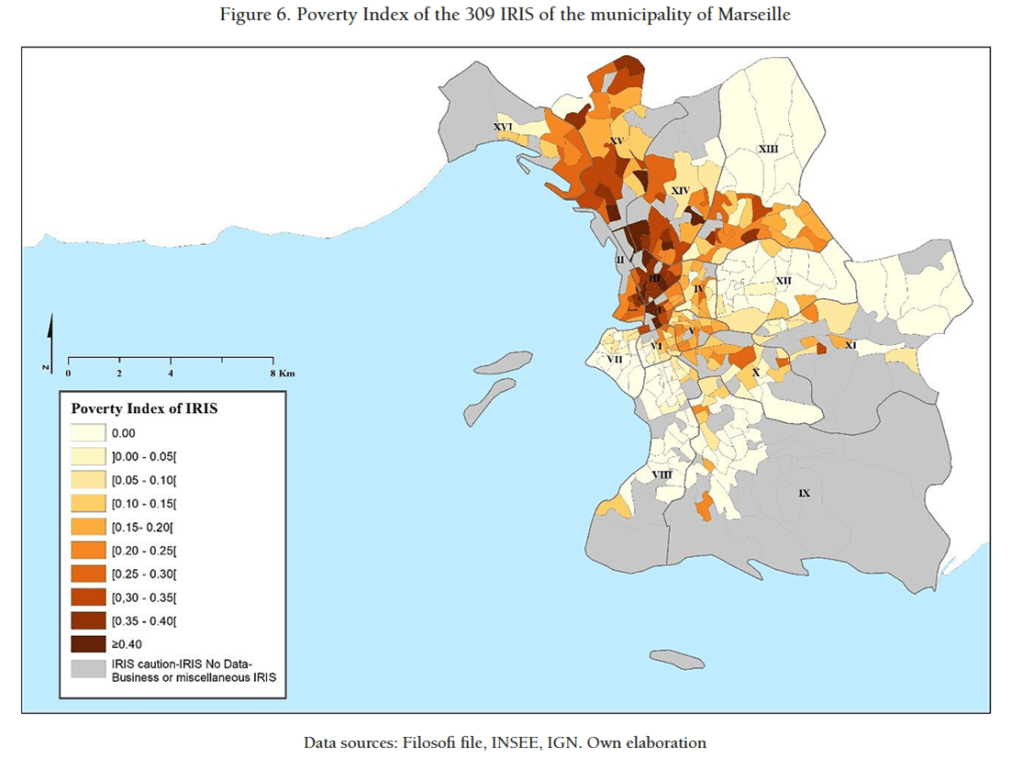
This spatial structuring of social disparities is one of Marseille’s most distinctive features. Unlike Paris, where poverty is often pushed further to the periphery, poor neighborhoods in Marseille remain visibly present within the city limits, and even in the center. Social housing complexes, dilapidated buildings, and more affluent areas often exist in close proximity to one another. Nevertheless, a pattern is evident: the areas most affected by poverty are located in the north of the city, near the Grand Port Maritime. These “quartiers Nord” are characterized by widespread poverty and should therefore not be confused with the city’s many cités (often ghettoized high-rise apartment blocks). Literature frequently describes Marseille as a city of extreme spatial contrasts. Poverty is not erased from the cityscape but remains a part of everyday urban life.
The revitalization of the city center has simultaneously led to intensified gentrification processes. Especially since the 1990s, new middle classes, students, and highly skilled professionals—often referred to as “neo-Marseillais”—have been moving into certain central districts of the city. The literature emphasizes the appeal of the Mediterranean lifestyle, cultural diversity, and comparatively affordable real estate prices. Areas particularly affected are touristically or symbolically gentrified, such as the Vieux-Port, La Plaine, and the Castellane area. However, these processes are often fragmented and uneven. Gentrification in Marseille frequently exists alongside extreme poverty and significant social insecurity.
Another distinctive feature of Marseille is the rapid growth of gated communities and gated communities since the 1990s, sometimes described as “Privatopia.” This development arose from a combination of private real estate development, security concerns, and urban planning heavily focused on investment and the automobile. The increasing closure of these communities leads to further social and spatial fragmentation of the city. Public spaces are reduced, pedestrian movement is hampered, and access to infrastructure is unequally distributed. At the same time, a growing contrast is emerging between gentrified and decaying neighborhoods, between the living spaces of an upper class that (often out of fear) does not want to mix with the lower class. Still, this kind of contrast is used by the city in order to promote its supposed diversity.
The dilapidation of old buildings remains a central issue. Particularly in parts of the city center, there is a marked neglect of older housing structures. The problems of dilapidated buildings became nationally visible after the collapse of several buildings in Noailles in 2018. Marseille thus often appears as a city of contrasts: on the one hand, large investment projects, tourist development, and cultural branding; on the other, decaying neighborhoods, precarious living conditions, and social insecurity.

This insecurity is evident not only in large-scale structural developments but also in the everyday streetscape of the city. Two examples of this are the cigarette vendors at the Marché des Capucins and the women braiding hair on the Canebière. The cigarette vendors are mostly young men who sell single cigarettes or packs informally and usually illegally. The hair braiders, in turn, are often Black women who sit in groups—frequently with children—in public spaces, braiding the hair of other Black people. This activity is not necessarily illegal, but it also often falls within the realm of informal or precarious self-employment. Both forms can be understood as expressions of urban insecurity. They exemplify forms of work outside of stable or formal employment and illustrate how social insecurity becomes a visible part of public space in Marseille.
Conclusion
In summary, Marseille exhibits a pattern of inequality that can only be partially explained by general developments in France. While the city initially followed the trajectory of high inequality during the Belle Époque and the weakening of traditional elites during the 20th century, as described by Piketty, its subsequent development was particularly strongly influenced by local factors: the loss of its colonial port function, postwar deindustrialization, and the later restructuring of the city through large-scale investment and urban renewal projects. These developments, in particular, have spatially fragmented Marseille in a unique way. Poverty, gentrification, tourist areas, and social insecurity often exist in close proximity. Inequality in Marseille thus appears as a visible structure of the urban space itself. The city exemplifies how economic structural change, urban policy, and social inequality can collectively shape a city’s character. This combination of deindustrialization, spatial segregation, and fragmented urban renewal makes Marseille a particularly interesting case study for research on poverty and inequality in France.
This text is naturally not meant to scare anyone off from Marseille. stories of crime especially are often exaggerated. In general the processes of gentrification have made some areas of the city more livable although the issue of justice in housing and amenities still remains.
Further Reading
- Marseille Privatopia
- Athens Social Atlas
- The End of the Rentiers: Paris 1842-1957 – Piketty, Gilles Postel-Vinay, Jean-Laurent Rosenthal. (PDF)
Sources
1. Maurin, Louis. 2011. “Les Villes Les plus Inégalitaires de France.” Observatoire Des Inégalités. November 2, 2011. https://www.inegalites.fr/Les-villes-les-plus-inegalitaires-de-France.
2. “Les Communes Les plus Touchées Par La Pauvreté.” n.d. Observatoire Des Inégalités. https://www.inegalites.fr/Les-communes-les-plus-touchees-par-la-pauvrete-2086.
3. Regnard-Drouot, Céline. « Chapitre V. La vie dure. Tensions dans le monde ouvrier ». In Marseille la violente. Rennes: Presses universitaires de Rennes, 2009. doi:10.4000/books.pur.101547.
4. Bechini, Thibault. 2014. “Marcel Roncayolo, L’imaginaire de Marseille. Port, Ville, Pôle.” Lectures. https://doi.org/10.4000/lectures.16705.
5. Gripsiou, Argyro, and Christophe Bergouignan. 2022. “The Internal Socio-Economic Polarization of Urban Neighborhoods, the Case of Marseille.” Investigaciones Geográficas, no. 77 (January): 103. https://doi.org/10.14198/ingeo.19432.
6.T irone, Lucien. 2008. “MARSEILLE : Croissance Démographique et Développement Urbain.” Encyclopædia Universalis. January 15, 2008. https://www.universalis.fr/encyclopedie/marseille/2-croissance-demographique-et-developpement-urbain/.
7. Daumalin, Xavier. « 12. La bourgeoisie d’affaires marseillaise face aux recompositions industrielles des années 1960-1990. Les fondements d’un désengagement ». In La désindustrialisation : une fatalité ?, édité par Jean-Claude Daumas, Ivan Kharaba, et Philippe Mioche. Besançon: Presses universitaires de Franche-Comté, 2017. doi:10.4000/books.pufc.21004.
8. Grzegorczyk, A. (2021). Residential segregation and socio-spatial processes in Marseille. Urban social sustainability challenge . Bulletin of Geography. Socio-economic Series, 52(52): 25-38. DOI: http://doi.org/10.2478/bog-2021-0011
9. Hoad, Phil. 2017. “Corrupt, Dangerous and Brutal to Its Poor – but Is Marseille the Future of France?” The Guardian. June 8, 2017. https://www.theguardian.com/cities/2017/jun/08/corrupt-dangerous-brutal-poor-marseille-future-france.
10. Audren, Gwenaëlle, and Virginie Baby-Collin. 2017. “Ségrégation Socio-Spatiale et Ethnicisation Des Territoires Scolaires à Marseille.” Belgeo. Revue Belge de Géographie, no. 2-3 (September). https://doi.org/10.4000/belgeo.18726.
11. Farmine, Nicolas. 2026. “Euroméditerranée, Ce Projet d’Aménagement Qui Revitalise Marseille.” Le Figaro. May 21, 2026. https://www.lefigaro.fr/marseille/euromediterranee-ce-projet-d-amenagement-qui-revitalise-marseille-20260521.
12. Dorier, Elisabeth. 2024. “Marseille Privatopia” Hypotheses.org. Zugriff: 26 Mai 2026. https://urbanicites.hypotheses.org/marseille-privatopia.
13. Aziz, Amir. 2024. “Marseille in uproar: secularism, multiculturalism, and urban degradation in the city of immigrants.” Identities, 1–20. https://doi.org/10.1080/1070289X.2024.2444106
14. Piketty, Thomas, and Arthur Goldhammer. “Capital in the Twenty-First Century.” Harvard University Press, 2014. http://www.jstor.org/stable/j.ctt6wpqbc.

